Ecommerce link building means getting other websites to link to your online store. It’s one of the most direct ways to improve your search rankings, grow traffic, and increase sales.
According to a 2026 Charle Agency analysis, organic search can drive roughly around 43% of all ecommerce traffic, making it the largest channel for most online retailers. Stores that focus on and invest in building authority through relevance and high-quality links consistently perform better than those that rely only on paid ads.
But the actual challenge is product and category pages. The pages that need to rank the most rarely attract any links on their own. No one voluntarily links to a product or service page, unlike the helpful guides and data studies.
This article will help you solve this problem, and you’ll learn the strategies that currently work for ecommerce stores.
Key Takeaways:
- Product pages rarely earn direct links, build authority through content assets, and route it via internal links.
- Ecommerce SEO delivers 317% average ROI over three years with a 9-month break-even.
- 86% of ecommerce sites lack optimized internal links, the most neglected step in this process.
- AI searches like ChatGPT are now helping people find products, get your brand mentioned online, and influence their recommendations.
- Digital PR and brand mentions can now drive traditional rankings and AI search visibility.
What is Ecommerce Link Building?
Ecommerce link building is the process of earning high-quality backlinks from other websites for your online store.
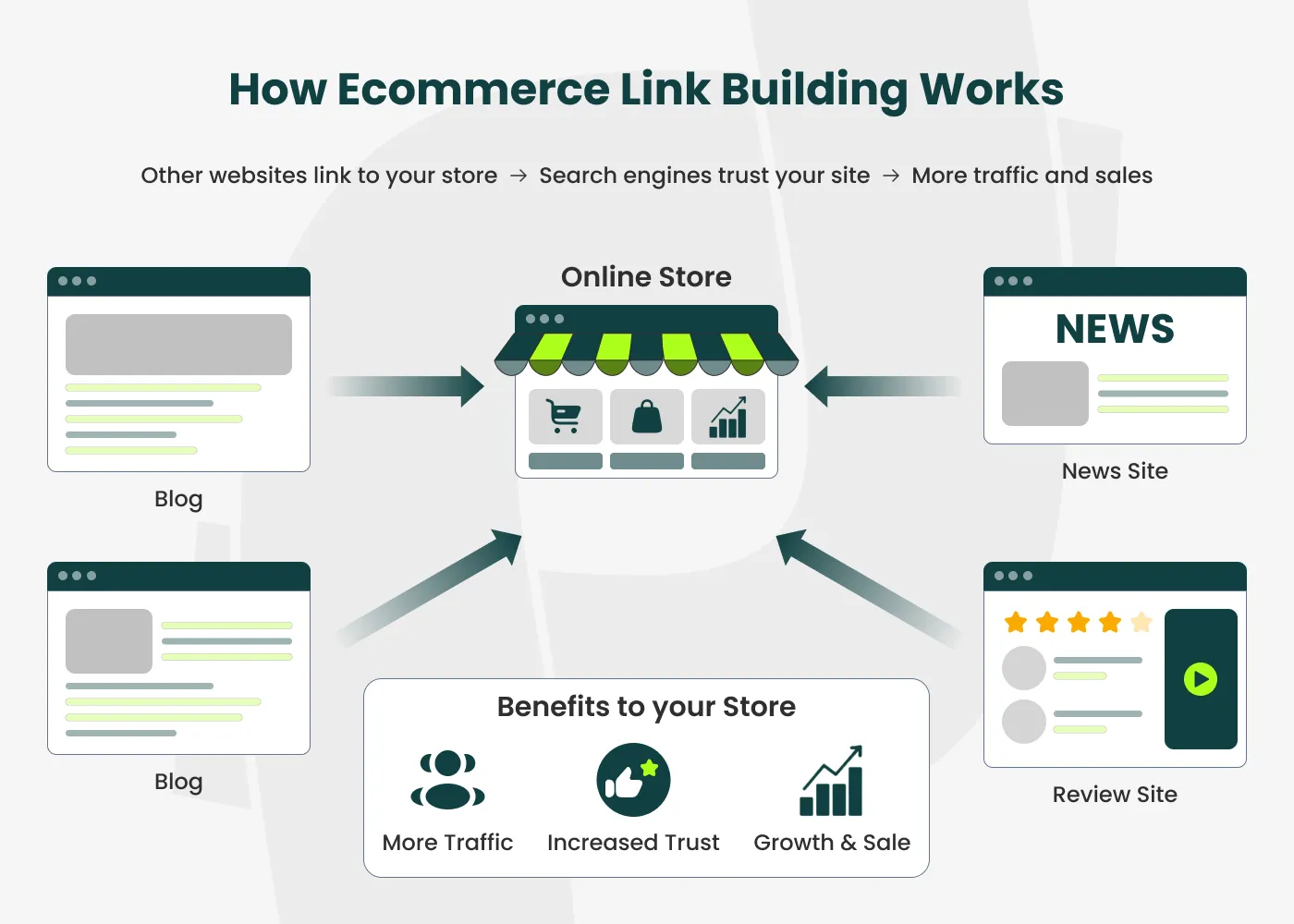
These links help your product and category pages rank higher on Google, can increase your site’s authority, and drive more traffic and sales. Backlinks work as trust signals; the more reputable sites link to you, the higher your pages rank.
Why Ecommerce Link Building is Different From Other Niches
Most of the link building strategies and advice are written for SaaS companies, publishers, or service businesses. Ecommerce sites face different problems.
The Product Page Problem
Your product pages are commercial, and they exist to sell. Even though your products are great, bloggers, journalists, and editors don’t link to them if your product pages look like an advertisement.
Let’s say a tech reviewer might link to an informational guide about choosing the right laptop, but won’t link to your page if it looks like a free ad for your store. BuzzStream Link Building Trends Report found that around 68% link builders prioritize links to blog posts, while only 14% prioritize links to product pages.
Content Competition is Intense
Ecommerce is a competitive environment because your direct competitors are Amazon, Walmart, and category giants with massive authority. A 2026 ALM Corp analysis shows in their study that organic click share dropped by up to 23% in product categories like headphones over 1 year. Paid results can now capture 36% of clicks in some niches.
That means every link you earn matters more, and relevance matters more than just volume.
Links Can’t Just Go Anywhere
For ecommerce stores, earning links isn’t an end goal; it’s just the starting point. You need a smart internal linking strategy that pushes the authority from your content pages to the product and category pages that can actually make you money.
Ecommerce Link Building Strategies That Work in 2026
Now that you’re familiar with ecommerce link building and understand why links matter and where they need to go, let’s get into the strategies to earn them.
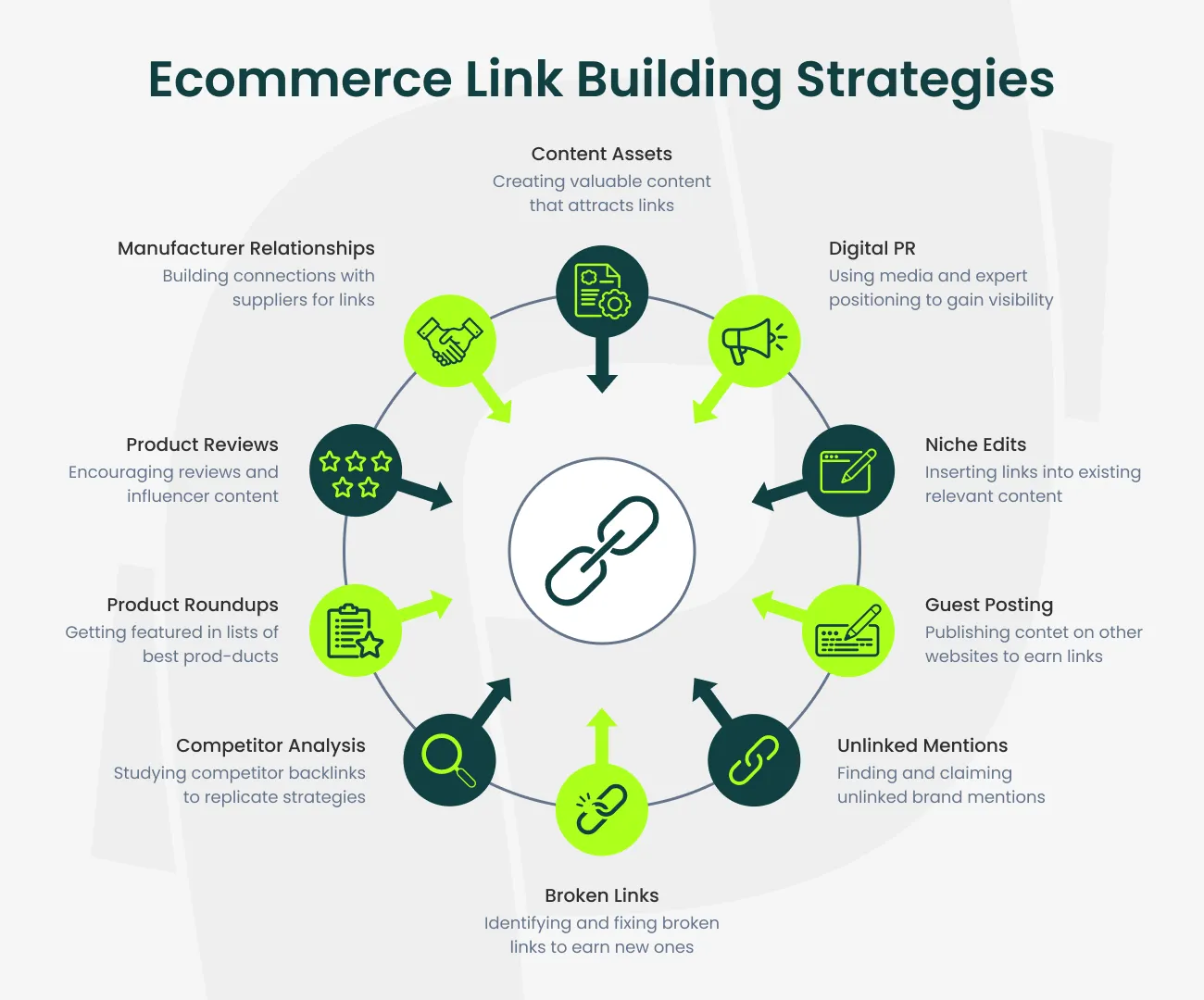
1. Build Content Assets Worth Linking To
Your content needs to solve problems, answer questions, or provide data people want to reference because product pages won’t earn links on their own.
Create content specifically designed to earn links, then connect it to your revenue pages via internal links.
For ecommerce stores, here’s what works best:
Buying guides
Guides that honestly compare products usually perform well. “How to Choose a Running Shoe for Your Foot Type” earns links because other types want to reference it, whereas “Buy Our Running Shoes” doesn’t.
Original data and surveys
Original data and surveys are important because journalists and bloggers need data to cite. Suppose you sell kitchenware, survey 500 home cooks about cooking habits, and publish the results. Blume, a wellness brand, surveyed women about their period experiences during puberty. The results earned links from Forbes and other high-authority publications.
Interactive tools and calculators
A mattress brand with a “sleep Quality Score” calculator or a paint company with a “Room Coverage Estimator” gives other sites a reason to link to it. Tools are underused in ecommerce that’s exactly why they work.
FAQ-style content targeting long-tail queries
These pages rank for question-based keywords and naturally attract links from forums and resource pages.
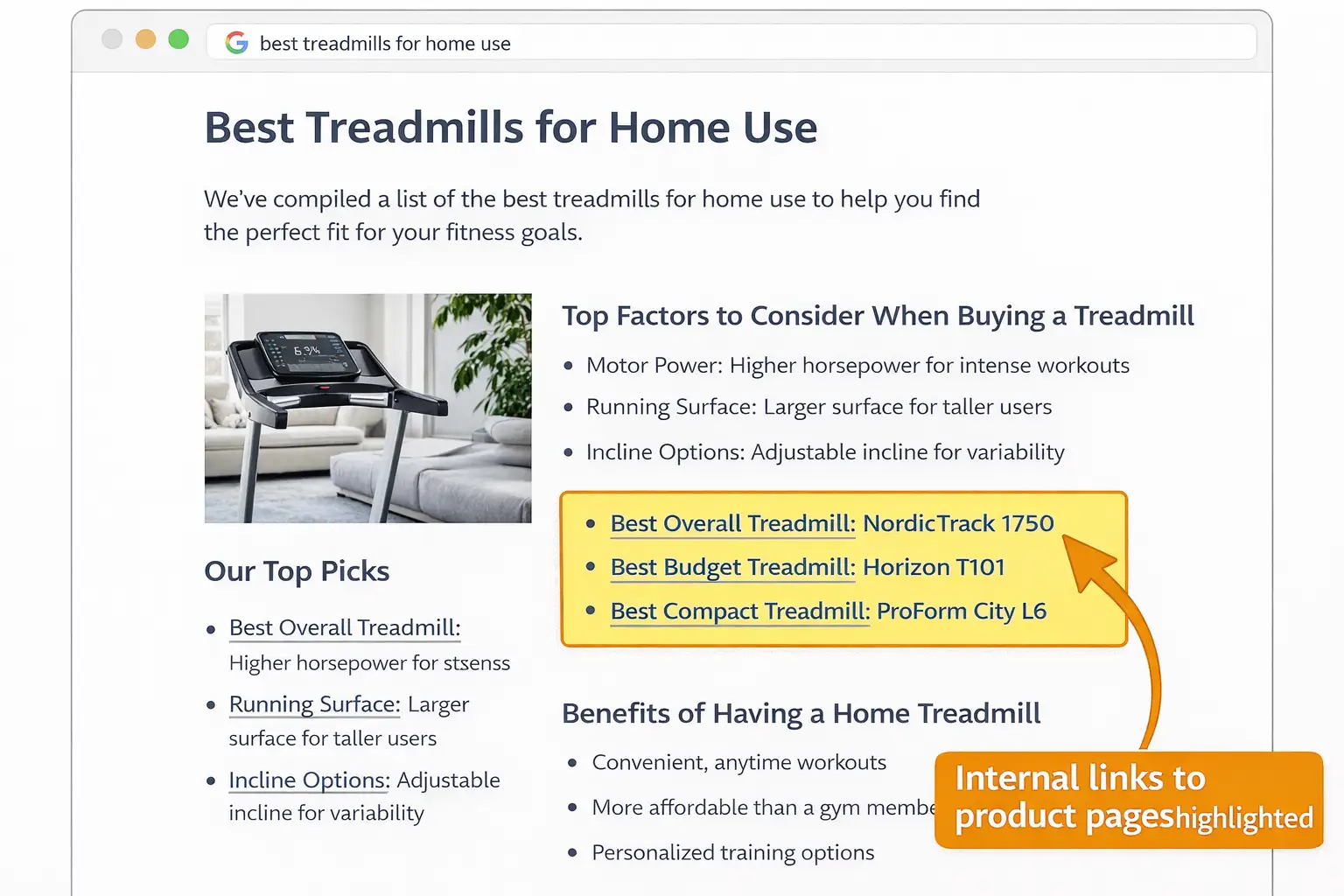
Tip – Critical Step Most Ecommerce Stores Miss:
Internal linking from the content assets to product and category pages. A buying guide that earns 50 links is only valuable if it links to the product pages that you want to rank.
2. Use Digital PR and Expert Positioning
Digital PR is the highest-impact link building strategy for ecommerce brands in 2026. It means creating stories that journalists and editors actually want to cover.
When a major publication features your brand or cites you as an expert, you earn two things at once. First, a high-authority backlink, and second, a brand mention.
Here’s how you can run digital PR for ecommerce:
Start by finding your news angle. A sustainable initiative, unique product design, or proprietary customer data.
Second, position your founder or product expert as a source. Respond to journalist queries on platforms like HARO, Featured, and Qwoted. A consistent 30 minutes per day builds a high-quality link over time.
Third, pitch niche publications. If your skincare brand has a dermatologist on staff, pitch them as an expert source for beauty editors covering ingredient trends.
Leveraging subject matter experts (SMEs) works the same. Suppose you sell fitness equipment. Collaborating with certified trainers on your content creates link-worthy assets, and those experts often share and link to content featuring their insights.
3. Niche Edits and Contextual Link Insertions
Niche edits are also known as link insertions, which place your link within existing, already-indexed content on other websites. Specifically for ecommerce, the most effective targets are blog posts and guides that already discuss your product category.
The image below is of a well-known website that naturally links to “Hurom juicer” in its article.
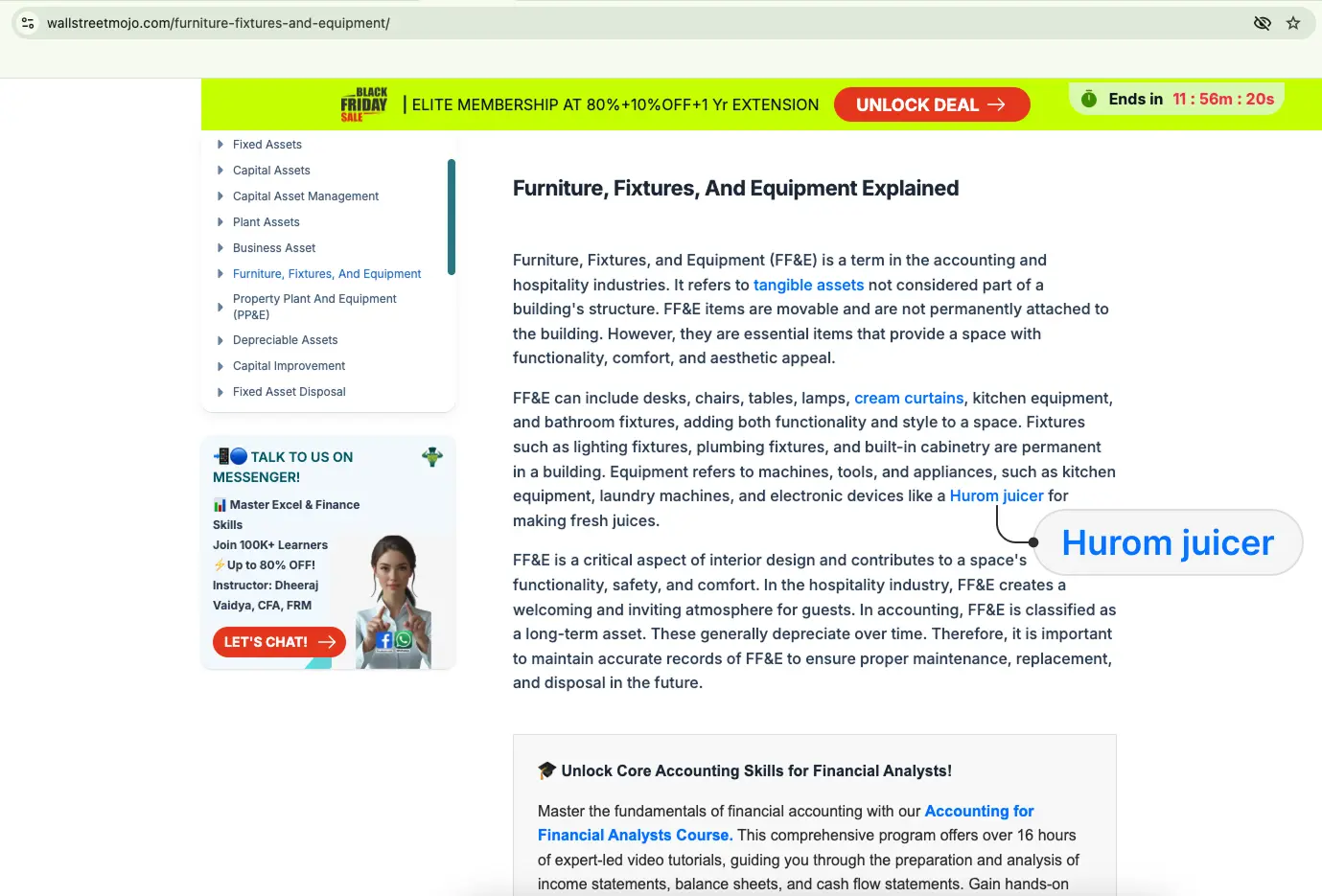
Because the content is already indexed and ranking, the link passes value easily. Best targets: articles titled as “best [product type],” “[product category] guide,” or “how to choose [product type]” articles with real organic traffic.
Here’s how you can implement niche edits:
- Identify websites in your industry that cover topics that relate to your products.
- Find specific pages where your link genuinely adds value for the readers.
- Reach out with a clear and specific reason why your link improves their content.
- Focus on relevance because it can beat authority. A DR 35 niche link can outperform a DR 70 general site with no relevance to the topic.
4. Guest Posting on Relevant Publications
Guest posting works when you contribute genuinely useful content to the relevant publications where your target customers already read, rather than publishing thin, keyword-stuffed posts on any blog.
You should focus on publications where:
- The audience of that publication and your customers’ preferences are similar.
- The site has real organic traffic (check that in Ahrefs or SEMrush).
- Your content offers something that the publication doesn’t already cover.
Now, if your question is what you should write about, then you can share your expertise on a specific topic rather than offering them a sales pitch. Suppose that a kitchen equipment retailer could write about “How Professional Chefs Choose Their Knives” for a food blog. The link back to the store is contextual and adds value for the readers.
5. Reclaim Unlinked Brand Mentions
If your store already has a public presence and people are mentioning your brand online but not linking to you, then it can be one of the easiest wins available. Because you can convert these mentions into links. You just need to ask them to make the mention clickable.
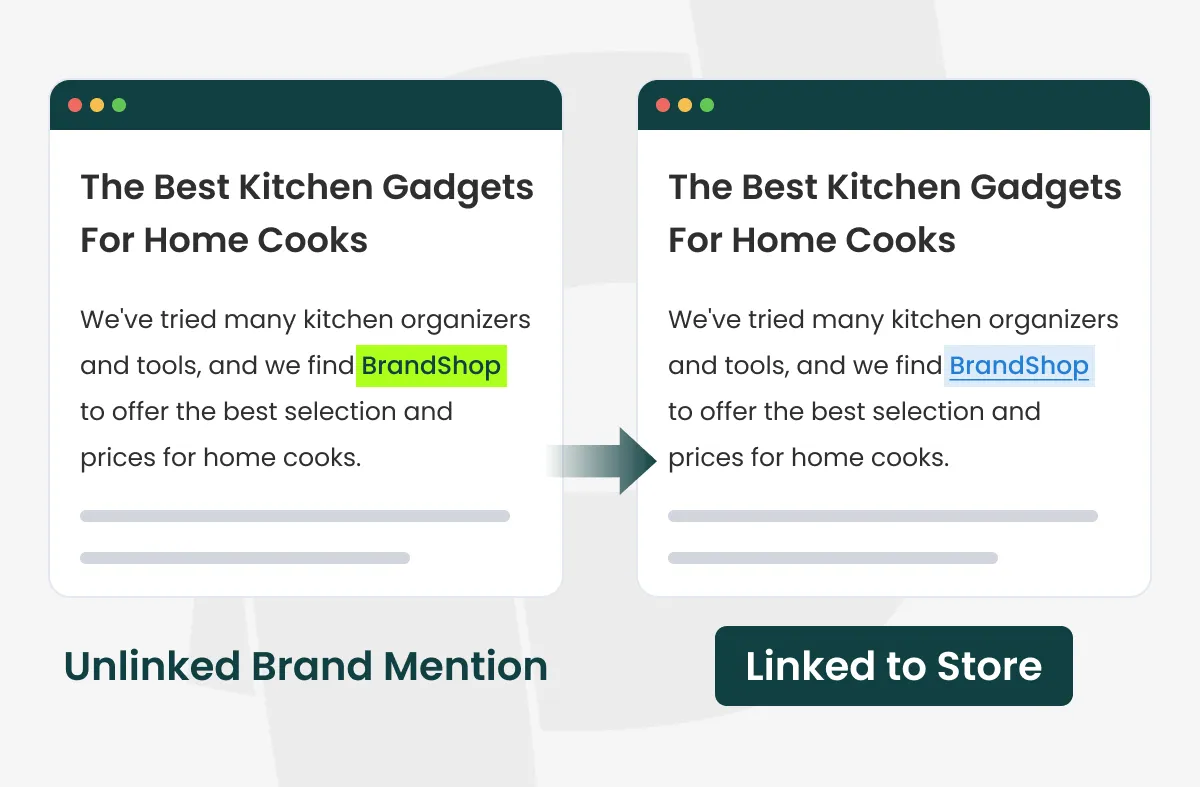
To find unlinked brand mentions, follow these:
- Set up Google Alerts for your brand name, product names, and any unique terms that are associated with your store.
- Use Ahrefs Content Explorer or a similar tool to search for your brand name and filter out mentions without hyperlinks.
- Finally, reach out with a simple, polite, and personalized request. Most website owners will add the link because you’re not asking for a favor; you’re improving the user experience for their readers.
This might not get you hundreds of links, but the links you do earn tend to be highly relevant, editorially placed, and genuinely useful.
6. Broken Link Building
Broken link building means identifying dead links on relevant sites, creating missing content to replace what the dead links pointed to, and suggesting your version as a replacement to the site owner.

Resources in your niches often contain numerous outbound links. Product guides go out of date; brands shut down. All of these create broken links that website owners don’t know about, and most will willingly swap in a working, relevant placement.
Here’s the process of broken link building:
- Use tools like broken link checker, Ahrefs or Check My Links to identify broken links on resource pages in your industry.
- Check what dead pages used to contain with the help of the Wayback Machine.
- If you have a relevant page or can create a better version on your site, reach out to the site owner and offer it as a replacement.
The response rate is higher than cold outreach because you’re solving a problem that the site owner already has.
7. Competitor Backlink Analysis and Replication
Studying your competitor’s link profile reveals the exact opportunities that exist. This is not guesswork; it’s real data.
- Start by picking 3-5 competitors ranking above you for your targeted keywords.
- Run their domain on Ahrefs or SEMrush to see their backlink profile.
- Look for common patterns, such as which content types attract the most links and which publications link to them.
- Make a list of targeted sites that are linking to your competitors but not to you.
- Create content or outreach pitches tailored to specific sites.
The goal is not to copy your competitors, but it’s about finding what’s working in your niche, finding the gaps, and filling them with something valuable.
If three of your competitors have links from the same niche blog, that means that blog is open to ecommerce content, and you should definitely be on their radar.
8. Get Featured in Product Roundups and “Best of” Lists
This is one of the high-impact strategies for ecommerce because it puts your products in front of ready-to-buy buyers while earning relevant links.
Roundups like “Best Running Shoes for Flat Feet” or “Top Kitchen Mixtures Under $300” rank well for the buying keywords. Getting featured earns you a contextual link from the content that attracts traffic.
Here’s how you can do product roundups:
- Search for “[your product category] + best” or “[product type] + roundup” in Google to identify the articles ranking on page one in search results.
- Reach out to the editor or author, offer a product for review, and provide a summary of why your product fits their list.
- Follow up once, but don’t spam their inbox if you don’t hear back. A pitch with a clear product angle does the work.
9. Earning Links Through Product Reviews and Influencer Content
Product reviews on niche blogs and YouTube channels can earn you contextual and relevant links. Choose reviewers whose audience matches your customers.
What you should look for in a review partner:
- They already have an engaged audience in your niche, not just a large following.
- Their site has real traffic and standards.
- They publish detailed, honest reviews rather than sponsored content dumps.
How you can approach them:
Send them a free product with a personal note. Avoid asking for a link directly; ask them to share their honest experience.
Note:
Links from sponsored reviews should be tagged under rel= “sponsored” as per Google’s guidelines. These links carry less SEO weight directly, but still contribute to your overall link profile, help to drive referral traffic, and build awareness.
10. Build Relationships with Manufacturers and Suppliers
If you sell products from the known brands, then those brands often have websites with “where to buy” pages, dealer directories, or partner listings. Getting your page listed on these pages earns you quality, relevant links from trusted sites.
Follow these steps to build relationships with manufacturers and suppliers:
- List every brand you have.
- Visit each brand’s sites and look for the partner pages, dealer listings, or “authorized retailers” section.
- Reach out to the brand’s marketing or sales contact and request inclusion.
This can be one of the simplest ecommerce link building strategies, but it’s often overlooked. These links are highly relevant. Google sees a link from a manufacturer to a reliable retailer as a strong trust signal.
How to Direct Link Equity to Product and Category Pages
Earning links to your blog content is just half the work. The real value comes from channeling that authority to the pages that generate revenue.
Internal linking architecture for ecommerce:
Build a clear hierarchy of your linkable content assets, such as guides, tools, and research, that should naturally link to relevant pages, which in turn link to individual product pages.
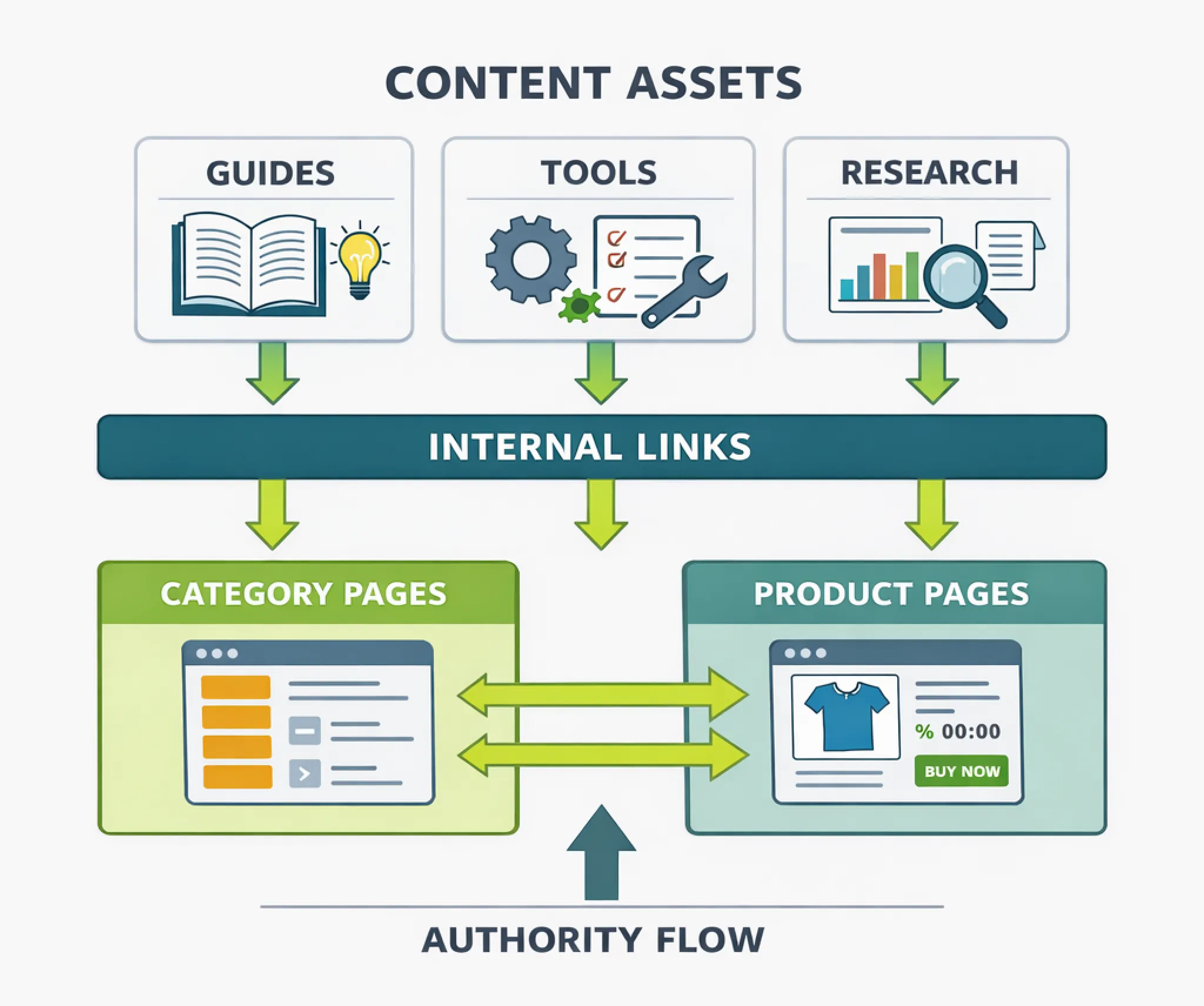
There are some rules to follow for effective internal linking. Let’s understand them,
- Every content asset should link to at least 2-3 relevant categories and product pages using descriptive anchor text, not with forced CTA like “check out our products”.
- Don’t overoptimize anchor text. Keep it a mix of exact-match, partial-match, and natural-language anchors.
- Review and update internal links quarterly; integrate new products and categories into the existing content.
Prioritize where you want to send your authority.
Not every product page needs the same level of attention when building internal links. Focus your authority where it drives results.
- Identify your valuable category and product pages. The one that targets your most competitive, highest-converting keywords.
- Analyze which content asset currently links to them. Most of the stores find that this number is close to zero.
- Add contextual internal links from your most important blog posts, such as the one with the most referring domains, to those commercial pages. Contextual internal links pass more equity and feel natural to the readers. Whereas forced CTAs are ignored by readers and search engines.
- Create new content specifically designed to support your undeserving product pages. If your best-selling category has no supporting content linking to it, then that’s your next content brief.
Ecommerce Link Building and AI Search Visibility
To understand this concept clearly, let’s look at the image below.
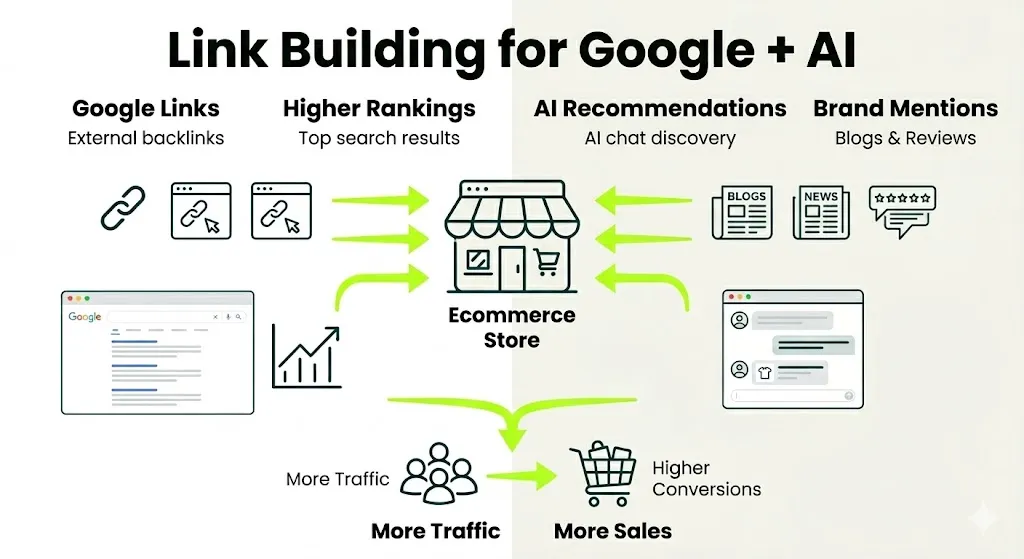
People now use AI platforms such as ChatGPT, Perplexity, Gemini, and others to discover and gather information about what they want to buy, which plays an important role in their buying decisions.
Suppose someone asks ChatGPT, “What’s the best espresso machine under $500?” Brands with a strong editorial footprint on the web get recommended.
A 2026 Search Engine Land analysis found that ChatGPT ecommerce traffic converted at a 31% higher rate than non-branded organic search across 94 ecommerce sites in 2025. The volume is still low; ChatGPT drove around 1.48% of organic revenue, but it’s growing, and the conversion-rate advantage is real.
This is the reason why digital PR and brand mentions matter more in ecommerce than ever. Where links build authority for Google rankings, brand mentions build the web presence that AI search engines use to decide which products and brands to recommend.
External editorial links + strong internal linking give you better Google rankings. Widespread brand mentions improve your AI search visibility.
How to Measure Ecommerce Link Building Results
Link building without tracking or measurement is guesswork; you should know which parameters to check, why they matter, and which link building tools to use to do it.
| What to Track |
Why it Matters |
Tool |
|---|---|---|
| Referring domains to content assets | Shows link building mementum. | Ahrefs, SEMrush |
| Organic traffic to product/category pages | Proves authority is reaching commercial pages. | Google Analytics, Search Console |
| Keyword rankings for commercial terms | Links should move these; if they don’t, check your internal links. | Ahrefs, SEMrush |
| Revenue from organic search | The bottom-line metrics. | GA4 ecommerce reports |
| Brand mentions across the web | AI search visibility signal. | Ahrefs Brand Radar, Google Alerts |
A healthy ecommerce link building campaign shows growth across all five parameters. If referring domains grow but product page rankings are steady or don’t move, then try fixing your internal linkings.
Common Ecommerce Link Building Mistakes
Here are some ecommerce link building mistakes that are most common, and you should try to avoid them.
Building Links Only to the Homepage
Your homepage already has the most authority on your site. Shift your focus to active link building efforts on category and product pages to drive equity deeper into your site.
Ignoring Internal Link Structure
This mistake is the most common and can cost ecommerce brands more rankings than any other gap. Eternal links without internal paths to commercial pages can feel incomplete.
Chasing High-DR Links With no Relevance
A link from a tech blog to your handmade candle store does almost nothing. Relevance is the multiplier that makes the link count.
Expecting Overnight Results
Link building is a compounding investment. Consistent efforts of over 6-12 months can produce results that short-term efforts can’t match. The BuzzStream survey found that around 75% of link builders are given six months or fewer to prove value, but the real gains often show up after that window.
Ignoring Content Entirely
If your site is 100% product listing without any blogs, guides, or tools, you’re missing the most effective link building strategy available. Even a small content library of 10-15 well-crafted guides gives outreach teams something that they can work with.
Chasing Volume Over Relevance
Even fifty links from unrelated blogs deliver less impact than five links from publications your targeting customers actually read. Through relevance to the topic, Google determines whether a link should influence your category rankings.
Not Tracking AI Search Visibility
AI search tools like ChatGPT and Google’s AI Overviews are becoming channels for product discovery. A Visibility Labs study analyzed 94 ecommerce sites and found that ChatGPT referral traffic converted at a 31% higher rate than non-branded searches. Strong brand authority built through quality links and mentions is what gets you recommended in these tools.
Conclusion
Winning at organic search in 2026 isn’t about the number of links; it’s more about relevance and pointing to the right pages, earned through strategies that build real authority.
Start with the strategies that are closest to revenue, such as product roundups and unlinked brand mentions. Then build your content library to create a long-term link earning. Connect everything with smart internal linking.
In business, organic traffic is an asset, but links are the medium through which you grow it.
Not sure how to build links that actually drive ecommerce sales?
Get a clear strategy to grow your rankings, traffic, and revenue with the right pages.
How long does ecommerce link building take to show results?
Most campaigns show measurable improvements in rankings within 3-6 months; however, the real revenue impact is observed within 6-12 months. The actual timeline depends on your domain’s existing authority, the competition level for your target keywords, and the quality of your internal linking distribution.
Can you build links directly to product pages?
Yes, but rarely, that’s the core challenge of ecommerce link building. Most site owners won’t link to commercial pages. Their expectations include truly unique or innovative products that earn press coverage, manufacturer pages that list retailers, and “best of” roundup posts where your product genuinely belongs.
How many links does an ecommerce site need?
There are no universal numbers. A site earning 5-10 quality, relevant links per month will outperform a site buying 50 low-quality links. Focus on growing your referring domains rather than the raw backlink count. Imagine there are two stores, one has 200 links from 15 websites, and the other has 80 links from 60 websites. The second store wins almost every time because the diversity of linking domains matters more than volume.
Is link building still worth it now that AI search is growing?
Yes, because link building earns authority for Google rankings, which is still important for the majority of ecommerce traffic. The brand mention that comes with editorial link building can improve your visibility in AI search. An Ahrefs 2025 study of 75,000 brands found that branded web mentions had the strongest correlation with AI Overview visibility.